Salmon and Sweet Potato
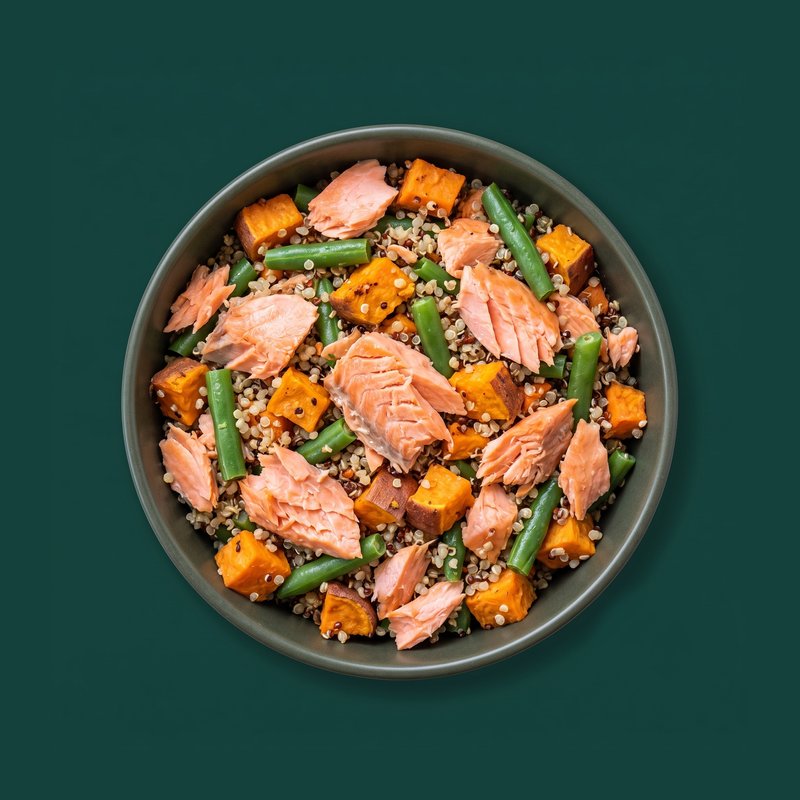
Cooked salmon with sweet potato and peas. Salmon is naturally rich in omega-3s that support skin and coat, so extra fish oil usually isn't needed here.
Make it your size
Ingredients ↻ updated
- salmon, fully cooked and completely deboned
- cooked sweet potato, mashed
- green peas, cooked soft
Optional boosters — ask your vet
Method
- Bake or poach the salmon until it's opaque and flakes easily (145°F). Check the flesh carefully for bones and remove the skin, then flake it apart. Salmon must be fully cooked — raw or undercooked salmon can make dogs seriously ill.
- Cook the sweet potato plain (bake or boil) until soft, then mash.
- Steam or boil the peas until soft.
- Cool everything (refrigerate within 2 hours), fold together gently, then portion into containers. Split it into 3–4 day portions — keep this week's in the fridge and freeze the rest once it's fully cooled. See food-safety tips ↓
How much to serve
Keep it to about 10% of your dog's daily calories — the amount vets (Tufts, WSAVA) say you can add over a complete kibble without unbalancing it. Feeding more, up to about a quarter of the bowl? Add a calcium source and check with your vet.
This batch runs ≈13 kcal per tablespoon. Not sure of your dog's numbers? Build your bowl portions it exactly for your dog.
Food safety — please don't skip this
These are the rules that keep a home-cooked topper safe. Figures are from FoodSafety.gov and the FDA.
- Cook to a safe temperature (use a thermometer): ground beef & pork 160°F; chicken & turkey 165°F; salmon 145°F or until opaque and flaking. Reheat leftovers to 165°F.
- Cool quickly — into the fridge within 2 hours of cooking (1 hour if your kitchen is above 90°F).
- Refrigerate at 40°F or below, use within 3–4 days. Split the batch: fridge half, freeze half, thaw midweek.
- Freeze at 0°F; best quality within about 2–3 months. Thaw in the fridge — never on the counter.
- Never include foods toxic to dogs: onion, garlic, chives, leeks; grapes/raisins; xylitol; macadamia nuts; excess salt; cooked bones.
Take it with you
Print or download the full recipe card, or drop in your email for a copy — every amount matches the batch size you set above.
These toppers sit over a complete-and-balanced kibble — around 10% of daily calories for a plain topper, or up to about a quarter of the bowl if you add a calcium source and your vet is on board. They are not a complete diet on their own. Introduce new food gradually and talk to your veterinarian, especially for a puppy, pregnancy, or a health condition. Calorie figures are approximate.
Sources
- Cook temps & reheating — FoodSafety.gov
- Cooling, fridge & freezer — FoodSafety.gov, FDA
- Foods toxic to dogs — ASPCA
- Salmon must be fully cooked — WSU
- The 10% rule — Tufts, WSAVA
- Calcium & fish oil — VCA, VCA
- Calories — USDA FoodData Central (approximate)